The Physical Activity Guidelines for Americans recommends we get at least 150 minutes of moderate-intensity physical activity per week. But exercise isn’t just about developing strong muscles and bones or even enhancing our cardiovascular health. As one doctor of chiropractic explains, it’s about so much more.
Importance of Physical Activity with Age
“You don’t just want to add years to your life,” says David J. Marcon, DC, CCSP, an American Chiropractic Association (ACA) member who practices in Cincinnati, Ohio, “you want to add life to years.” Regular physical activity helps you accomplish this goal.
“We are living a lot longer,” says Dr. Marcon. “Because of that, we have tremendous years of life where we can’t be independent or complete activities of daily living.” These activities include getting dressed or showering on your own.
Notably, nearly three in four adults living to the age of 65 will require long-term services at some point. Live to the age of 85 and you have a 50% chance of needing help with activities of daily living. Getting and staying physically active can help protect your independence as you age by providing the fitness needed to perform these actions.
Being Fit May Not Mean What You Think
Many people think of fitness as having a certain physique or hitting specific exercise goals. Yet, neither of these necessarily means that a person is fit. “Being fit used to mean living long enough to hit one’s reproductive years and have offspring,” explains Dr. Marcon. “However, the more accurate definition of fitness today is to have the ability to adapt to or cope with the environment you are living in.”
This means being able to get out of bed every morning, get yourself meals, tend to your hygiene, and use the toilet without assistance. This is even more important nowadays when people are having fewer children, many of which move away. This leaves no one there to care for them as they get older, making it critical to retain the fitness needed to care for oneself.
Why Cardio and Strength Training Aren’t Enough
Ask someone who looks fit what they do for exercise, and they’ll likely tell you about their cardio and weight-lifting routine. Instead, Dr. Marcon states that developing a higher level of fitness involves thinking beyond just cardiovascular endurance and strength. It also includes working on your power, balance, agility, flexibility, speed, coordination, accuracy, and stamina. It even requires looking after your mental health.
“Most of the day, we should be in ‘chill mode,’” says Dr. Marcon. We should only feel elevated during exercise or if we’re suddenly frightened, such as by seeing a mouse. If you spend too much time in fight-or-flight (which can occur during periods of high stress), this can affect your heart rate variability, ultimately hurting your health.
Heart rate variability (HRV) refers to variation in the timing between heartbeats. “We should strive for a higher HRV,” Dr. Marcon says, keeping our heart rate lower most of day. Exercise helps by improving our ability to adapt to physical stresses, lowering our normal heart rate. Although, it’s important not to do too much as overtraining can reduce HRV, as can getting inadequate recovery time.
To Avoid Feeling Overwhelmed, Start Small
Developing an exercise habit isn’t easy. Just ask the 87% of Americans who have failed to keep at least some of their New Year’s resolutions by the end of January. To increase your chances of success, start small. “This is a marathon versus a sprint,” says Dr. Marcon.
Starting small also allows you to have small successes. “Every time you succeed, it kind of builds your confidence and allows you to step a bit further with your activities and changes,” Dr. Marcon says.
It’s also important to keep an objective record of your fitness. “In our society today, if we don’t get what we want right away, we don’t think we’re making progress,” explains Dr. Marcon. Keeping a record of how easy or hard an activity feels enables you to see your progress.
Dr. Marcon likens it to his chiropractic patients who don’t feel like they’re progressing with treatment. When he shows them records that show they used to only be able to bend their head 15 degrees and it hurt but now they’re able to bend it 25 degrees without pain, they’re amazed. They made progress but didn’t realize it—until they reviewed the records.
What If You Don’t Like to Exercise?
Not everyone likes to work out. What if you fall into this category? Don’t just think of physical activity as something you must do for good health with age. Consider the social benefits it can provide.
It’s common as we get older to have fewer social contacts. Family moves away. Our friends die before us, leaving us feeling lonely. “As we limit our social contact, not only is our body eroding but so is our nervous system,” says Dr. Marcon. “We need connections.” Exercise can be a great way to build these connections with others while also keeping us motivated.
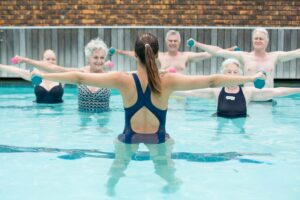
That’s why Dr. Marcon recommends joining a fitness class. These are available at gyms, recreational centers, and even senior centers. At first, it might be a challenge to go, but keep at it. “Next thing you know, you’re going because you like the group,” says Dr. Marcon. “They help raise you up both physically and mentally.”
Your Chiropractor: Your Partner in Fitness
While chiropractors specialize in musculoskeletal health, they can also help you reach your fitness goals. They can also show you activities you can do to move around more easily and with less pain. Practice those movements in their office so you can see how they’ll feel when doing them at home. This can reduce the fear you may have for how the activity feels.
Dr. Marcon further recommends getting a handout that shows you how to do the stretches or exercises step by step. Keep it someplace where you’ll see it when you need it most, such as placing it by your office chair where you typically get a sore back. Every time you see it, you’ll be reminded to do the exercise.
Also, don’t be afraid to ask your chiropractor questions about your health. Chiropractors often share information related to health and wellness with patients, and they are trained to diagnose and refer patients to other providers when necessary. For example, Dr. Marcon had a patient who complained of headaches. After learning that the head pain started after she’d gone to the dentist, he suggested that she go back and ask them to investigate further. They did and found an issue. “We aren’t going to necessarily correct all your issues with an adjustment,” Dr. Marcon says, “but we’re a trusted health source.”
Written by Christina DeBusk, a freelance contributor to Hands Down Better.